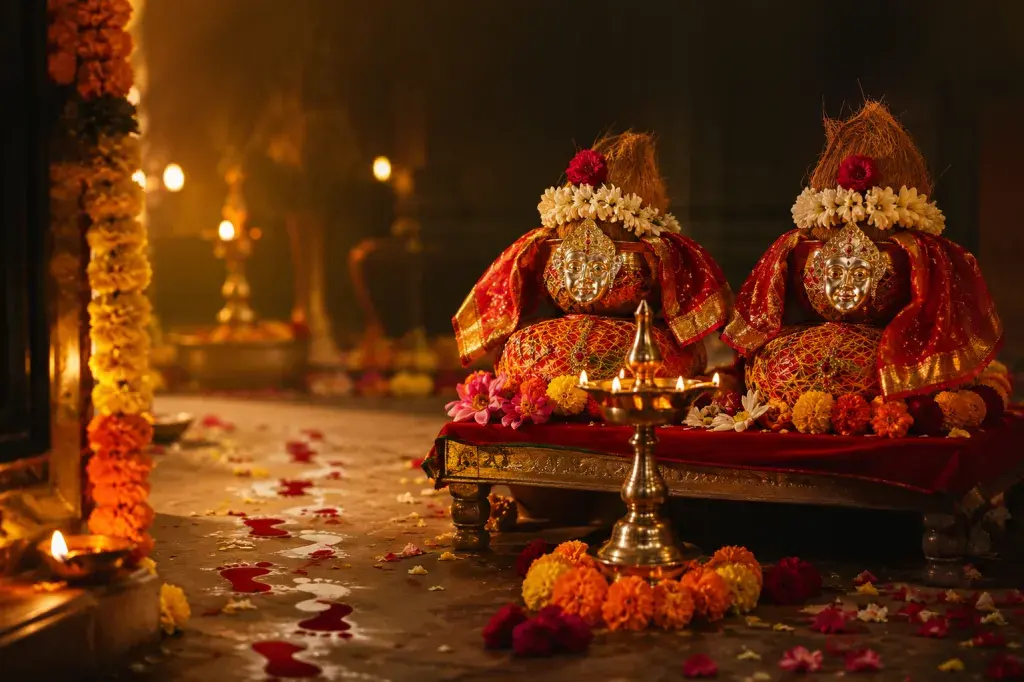
Jyeshtha Gauri Avahan
Goddess Gauri (Mahalakshmi)
When it falls
The date shifts because it tracks the moon, not the Gregorian calendar.
Calculated for India (IST) using precise Panchang astronomy. Dates can shift by a day at locations far to the east or west.
Significance of the welcoming day
Jyeshtha Gauri Avahan opens the three-day Gauri festival that sits within the larger ten-day Ganeshotsav. Avahan means invocation or invitation, and on this day the Gauris are welcomed into the home much as a beloved relative would be. In Maharashtra the Gauris are widely understood as Gauri (Parvati), the mother of Lord Ganesha, arriving to visit her son during the days he is being worshipped. Many households install a pair: Jyeshtha (the elder) and Kanishtha (the younger) Gauri, honoured together as Mahalakshmi.
The three Gauri days are fixed by nakshatra (the lunar mansion), not by tithi, so they fall on three consecutive nakshatras: the arrival on Anuradha, the main worship on Jyeshtha, and the farewell on Mula. This is why the welcoming day depends on when Anuradha prevails in the bright fortnight of Bhadrapada rather than on a fixed lunar date. The Gauris are represented by metal, terracotta, or painted masks mounted on a body frame, then dressed as married women in fine sarees and adorned with ornaments.
The mood of the day is one of welcome and homecoming. Small footprints of Lakshmi are drawn from the threshold inward toward the shrine, and the deities are symbolically walked through the house and shown the family's grain store, water source, and signs of prosperity before being seated. The tone is warm and domestic rather than solemn, and it sets up the principal worship that follows on the second day, Jyeshtha Gauri Pujan.
Rituals & observance
The welcoming day centres on inviting the Gauris in, seating them, and adorning them. Customs vary by family, but the core sequence is consistent.
- Drawing Lakshmi's footprints: small footprints are drawn (with rangoli or kunku, vermilion) from the doorway to the shrine, marking the path along which the Gauris are welcomed inside.
- Walking the Gauris in: the deities are symbolically carried through the home and shown the household's grain, water source, and signs of plenty, a gesture inviting prosperity into the family.
- Seating the Gauris: the masks are mounted on a body frame and placed at the shrine, often beside the household Ganpati installed earlier in Ganeshotsav.
- Dressing and adorning: the Gauris are dressed as married women in fine sarees and decorated with ornaments, flowers, and a haar (garland).
- Lamp and first offering: a lamp is lit and a simple first naivedya (food offering) is placed before the seated deities on the evening of arrival.
- A festive welcoming evening: family gather for aarti and singing, keeping the tone warm and celebratory as the guests are settled in for their stay.
Regional variations
How this date is determined
with the Moon in the 17 nakshatra, reckoned by the afternoon (aparahna).
Dates are computed to astronomical precision (NASA/JPL ephemeris), in line with traditional panchang.