Jagannath Rathyatra
Lord Jagannath
When it falls
The date shifts because it tracks the moon, not the Gregorian calendar.
Calculated for India (IST) using precise Panchang astronomy. Dates can shift by a day at locations far to the east or west.
Significance & story
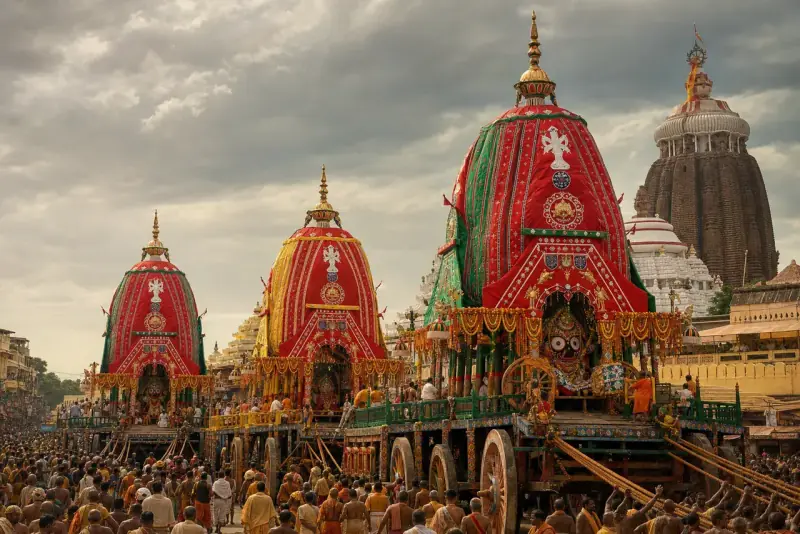
Rathyatra means "chariot journey." For most of the year Lord Jagannath — a form of Krishna (Vishnu) — stays within the great temple at Puri, in Odisha. On this one day he, his elder brother Balabhadra and their sister Subhadra are carried out and placed on three enormous wooden chariots, which thousands of devotees pull by hand through the main street. The idea at the heart of the day is simple and unusual: instead of people coming to the deity, the deity comes out to the people. Anyone can see and serve him, regardless of who they are.
The journey is to the Gundicha Temple, a short distance away, often described as the deity's garden house or the home of his aunt. Jagannath stays there for about a week before the return procession, known as Bahuda Yatra, brings the chariots back. The deities and the chariots are made and rebuilt in wood — fresh chariots are constructed each year — which ties the festival to craft, season and renewal rather than to a fixed permanent image.
The build-up matters as much as the day itself. The deities are bathed in the Snana Yatra ceremony shortly before, after which they are kept out of public view for a period of recovery (Anavasara) and then revealed again. Rathyatra is the moment they emerge. It sits in the same bright fortnight of Ashadha that leads into Devshayani Ekadashi, the day Vishnu is said to begin his long rest, so the season carries a strong Vaishnava current.
Rituals & observance
How Jagannath Rathyatra is kept:
- Three chariots are built fresh each year and lined up before the temple: Nandighosa for Jagannath, Taladhwaja for Balabhadra and Darpadalana (also called Devadalana) for Subhadra, each a different colour and height.
- Before the pulling begins, the Chhera Pahara is performed — the deities' chariots are swept with a gold-handled broom and sprinkled with water and sandalwood, a gesture that the highest and the humblest stand equal before the Lord.
- Devotees take hold of long ropes and pull the chariots by hand along the route to the Gundicha Temple; taking part in the pulling, or even touching the rope, is considered a great blessing.
- The deities stay at the Gundicha Temple for roughly a week, where they are worshipped, before the return procession (Bahuda Yatra) brings them back toward the main temple.
- Beyond Puri, communities and temples hold their own chariot processions on the same day, pulling smaller raths through local streets with kirtan and offerings.
Regional variations
How this date is determined
Observed on the Dwitiya tithi of Ashadha (Shukla paksha), reckoned by sunrise (udaya tithi). Should the tithi fall across two days, tradition keeps the earlier day (purva-viddha).
Dates are computed to astronomical precision (NASA/JPL ephemeris), in line with traditional panchang.