Guru Nanak Jayanti
When it falls
The date shifts because it tracks the moon, not the Gregorian calendar.
Calculated for India (IST) using precise Panchang astronomy. Dates can shift by a day at locations far to the east or west.
Significance & story
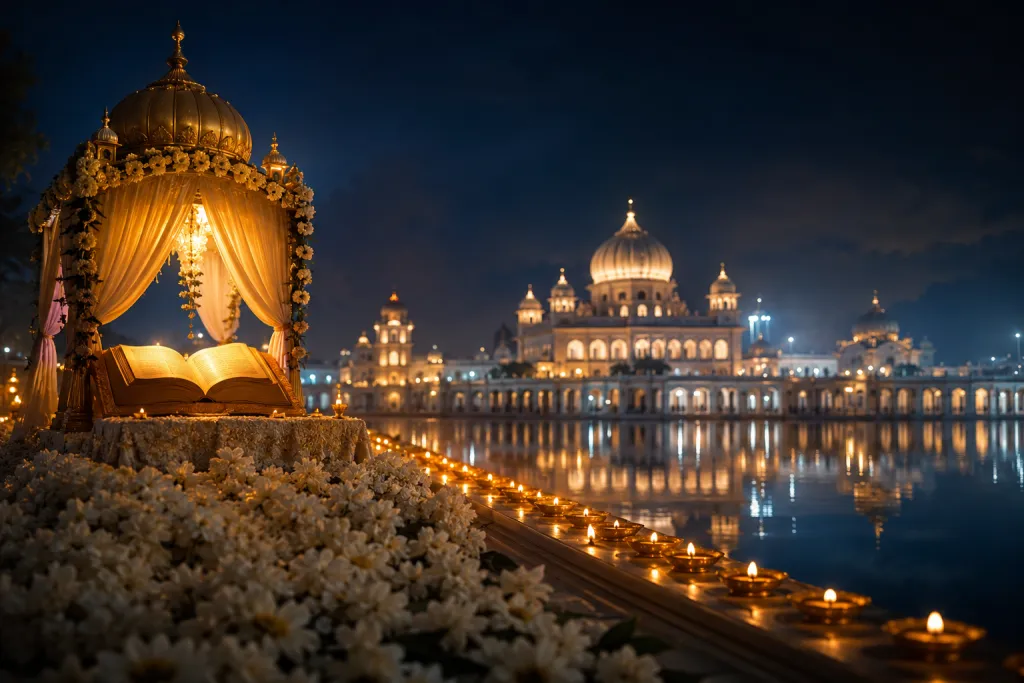
Guru Nanak Jayanti celebrates the birth of Guru Nanak Dev Ji, the founder of Sikhism and the first of its ten Gurus. The day is called Prakash Utsav, the festival of light, because his birth is remembered as the coming of light and wisdom. It is among the most important festivals in the Sikh calendar and is kept across India, most of all in Punjab.
Guru Nanak taught a few clear truths that still shape Sikh life: that there is one God, that all people are equal regardless of caste, creed, or gender, that one should earn an honest living, and that the highest worship is seva, selfless service to others. His teachings were gathered into hymns that form part of the Guru Granth Sahib, the holy scripture honoured as the eternal Guru, and the day turns on the reading and singing of that scripture.
The festival falls on Kartik Purnima, the full moon of the month of Kartik, usually in November, and therefore on the same day as Kartik Purnima and Dev Diwali. In the days before, devotees hold early-morning hymn processions, and a continuous forty-eight-hour reading of the scripture is completed on the day itself. The mood is devotional and communal, centred on the gurdwara, on shared worship, and on the langar that feeds all who come.
Rituals & observance
Observance centres on the gurdwara, on scripture, and on community, in the days before and on the day itself. Common practices include:
- Prabhat Pheris (dawn processions): in the days leading up to the festival, devotees walk through neighbourhoods at dawn singing hymns (shabads), so that the approach of the day is marked with kirtan.
- Akhand Path (continuous reading): a forty-eight-hour unbroken reading of the Guru Granth Sahib is carried out and completed on the day of the festival.
- Nagar Kirtan (street procession): a procession led by the Panj Pyare carries the holy book through the streets, accompanied by hymn-singing, music, and displays of gatka (a traditional martial art).
- Kirtan and katha at the gurdwara: congregational hymn-singing (kirtan) and discourses (katha) on Guru Nanak's life and teachings are held through the day.
- Langar (community meal): the free community kitchen serves a meal to all who come, regardless of background, expressing the teaching of equality and selfless service (seva).
- Seva and charity: many devotees take part in voluntary service and giving, in keeping with the Guru's emphasis on honest living and care for others.
Regional variations
How this date is determined
Observed on the full-moon day (Purnima) of Kartik (Shukla paksha), reckoned by sunrise (udaya tithi).
Dates are computed to astronomical precision (NASA/JPL ephemeris), in line with traditional panchang.