Gopalkala
Lord Krishna
When it falls
The date shifts because it tracks the moon, not the Gregorian calendar.
Calculated for India (IST) using precise Panchang astronomy. Dates can shift by a day at locations far to the east or west.
What Gopalkala means
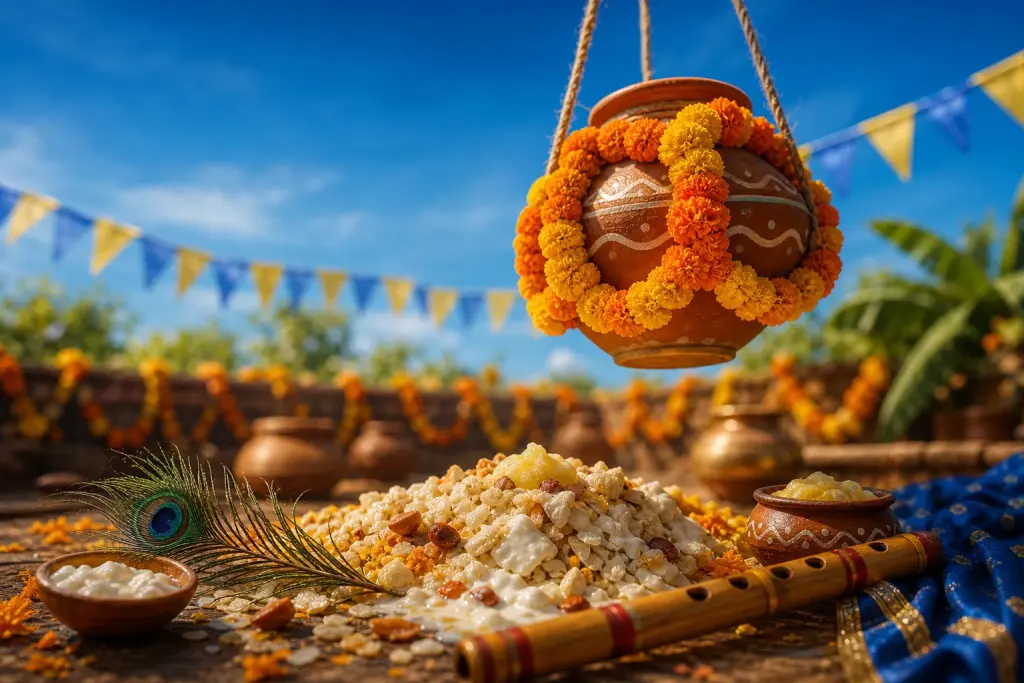
Gopalkala is observed on the day after Krishna Janmashtami, on Bhadrapada Krishna Navami, usually in August or September. The name comes from gopalkala, a mixed offering of beaten rice (poha), curd, milk, butter and fruit. In the stories of Krishna's boyhood in Gokul and Vrindavan, he and his gopa (cowherd) companions would pool whatever food they had carried out to graze the cattle and share it together, and gopalkala recalls that simple, communal meal. On this day the mixture is prepared, offered to Krishna, and then distributed.
The day's most visible custom is Dahi Handi, which reenacts the child Krishna's habit of stealing curd and butter. To keep the butter out of his reach, the women of the village are said to have hung their pots high from the ceiling, and the young Krishna and his friends would form a chain to climb up and reach them. In memory of this, an earthen pot (handi) filled with curd, butter and other treats is strung up high in streets and courtyards, and teams of young people known as Govinda troupes build human pyramids to climb up and break it.
Together the two customs give the day its character: the gopalkala feast carries the warmth of sharing, while Dahi Handi carries the mischief and play of Krishna's childhood. It is a lively, communal street festival rather than a solemn observance, and in Maharashtra it has grown into a large public event with troupes, music and crowds gathering around the hanging pots.
Rituals & observance
Gopalkala blends temple worship with a public street celebration. The main elements are the shared prasad and the Dahi Handi, and customs vary by town and troupe.
- Preparing the gopalkala: the mixed prasad of beaten rice (poha), curd, milk, butter and fruit is made, offered to Krishna, and then shared, recalling the meal Krishna ate with his cowherd friends.
- Temple worship of Krishna: the morning after Janmashtami, prayers and bhajans to Krishna continue at homes and temples, often with images of the child Krishna (Bal Gopal) honoured.
- Hanging the Dahi Handi: an earthen pot filled with curd, butter, fruit and small gifts is strung up high across a street or courtyard, set deliberately out of easy reach.
- Building the human pyramid: teams of young people, the Govinda troupes, form layered human pyramids so that one climber can reach and break the pot, scattering its contents as prasad below.
- Music, processions and gatherings: drumming, songs and chants of Govinda accompany the day, with crowds and communities gathering around the hanging pots to cheer the troupes.
- Sharing the broken prasad: once the pot is broken, the curd, butter and sweets are shared among those present, carrying the spirit of the gopalkala feast into the street celebration.
Regional variations
How this date is determined
Observed on the Navami tithi of Bhadrapada (Krishna paksha), reckoned by sunrise (udaya tithi).
Dates are computed to astronomical precision (NASA/JPL ephemeris), in line with traditional panchang.