Gita Jayanti
Lord Krishna
When it falls
The date shifts because it tracks the moon, not the Gregorian calendar.
Calculated for India (IST) using precise Panchang astronomy. Dates can shift by a day at locations far to the east or west.
Why Gita Jayanti is observed
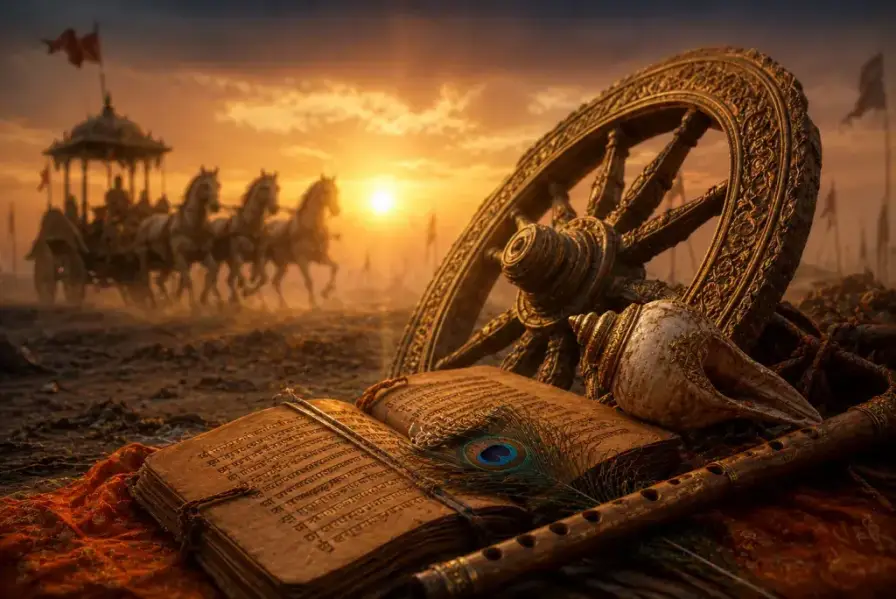
Gita Jayanti marks the day the Bhagavad Gita was spoken. By tradition, it was on this day that Lord Krishna delivered the Gita to the warrior Arjuna on the battlefield of Kurukshetra, at the start of the Mahabharata war. Arjuna, facing his own kinsmen across the field, lost the will to fight; Krishna's reply to that crisis became the seven hundred verses of the Gita. The festival falls on the eleventh lunar day (ekadashi) of the bright fortnight (Shukla paksha) of Margashirsha, which is also kept as Mokshada Ekadashi.
Unlike most festivals, Gita Jayanti is not the birthday of a deity but the anniversary of a text. That shapes how it is kept. The Gita is treated less as scripture to be worshipped from a distance and more as a conversation about duty, doubt, and how to act when the right course is unclear. Its themes are practical: doing your work without being ruled by the result, steadiness of mind under pressure, and acting from responsibility rather than fear.
Because the day also coincides with Mokshada Ekadashi, the two observances overlap for many households. The Ekadashi fast and the reading of the Gita are often kept together, so the day carries both the discipline of a Vishnu ekadashi and the study of Krishna's teaching.
Rituals & observance
Gita Jayanti is observed more through reading and reflection than through elaborate ritual. Customs vary by household and tradition, but these are the common threads.
- Read or recite the Bhagavad Gita, in full where possible, or at least selected chapters. Group recitations and Gita paths are held in many temples and homes.
- Keep the ekadashi fast that falls on this day, since Gita Jayanti coincides with Mokshada Ekadashi. Practice ranges from a waterless fast to taking only fruit, milk, and non-grain (phalahar) foods.
- Offer worship to Lord Krishna, placing a copy of the Gita on the home shrine and offering flowers, incense, and tulsi.
- Attend Gita discourses or study sessions, where verses are read and explained; many schools and institutions hold readings on this day.
- Give in charity, especially copies of the Gita or food, in keeping with the ekadashi's emphasis on merit.
Regional variations
How this date is determined
Observed on the Ekadashi tithi of Margashirsha (Shukla paksha), reckoned by sunrise (udaya tithi).
Dates are computed to astronomical precision (NASA/JPL ephemeris), in line with traditional panchang.