Ganesh Jayanti
Lord Ganesha
When it falls
The date shifts because it tracks the moon, not the Gregorian calendar.
Calculated for India (IST) using precise Panchang astronomy. Dates can shift by a day at locations far to the east or west.
Significance & story
Ganesh Jayanti marks the birth of Lord Ganesha, the elephant-headed deity revered as the remover of obstacles and the lord of beginnings, in the Magha tradition. It is also called Maghi Ganesh Jayanti or Tilkund Chaturthi, and falls on Magha Shukla Chaturthi, the fourth tithi of the bright fortnight of Magha, usually in January or February. By custom the principal worship is kept at midday (madhyahna), the time held to be Ganesha's hour of appearance.
It is distinct from Ganesh Chaturthi, and the two are easily confused. Ganesh Chaturthi falls in Bhadrapada, around August or September, and is the large public Ganeshotsav with grand pandals and immersion processions. Ganesh Jayanti, by contrast, is the quieter Magha birthday, kept mainly in Maharashtra, Goa, and the Konkan with worship at home and in temples rather than as a large civic celebration.
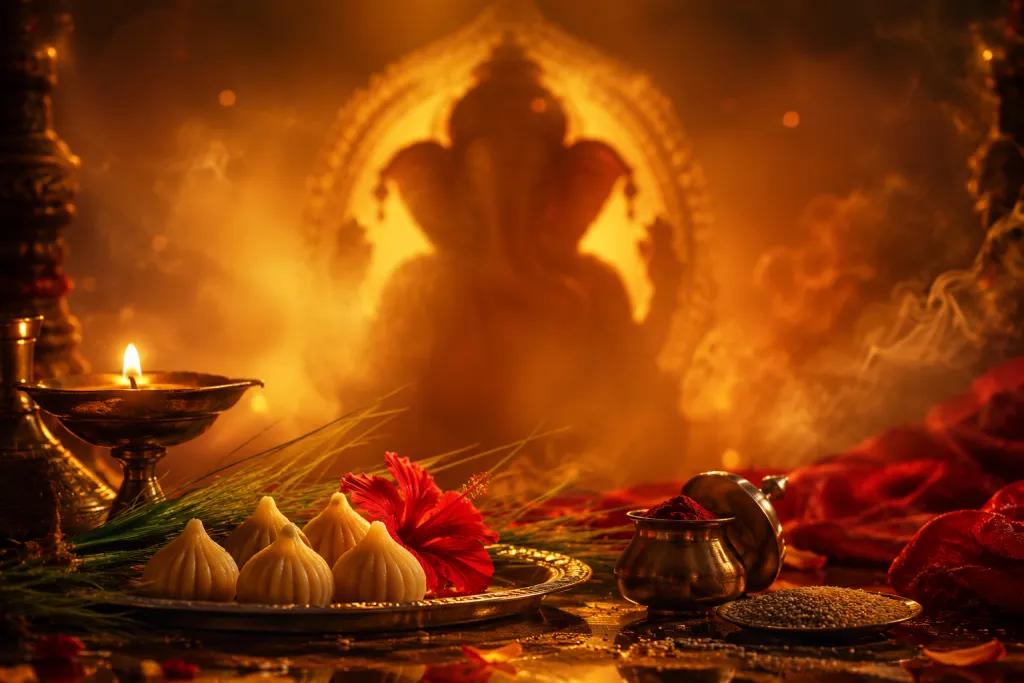
Til (sesame) is closely tied to the day, since Magha is the sesame season, which is why it is also known as Tilkund Chaturthi. Devotees offer til-based sweets such as the til-laddu, and in many homes a small clay (or til) image of Ganesha is made and worshipped. The day is devotional and domestic in tone, with families gathering for the midday puja and visiting Ganesha temples, including the Ashtavinayaka shrines of Maharashtra.
Rituals & observance
Observance is home-and-temple centred, with the main worship at midday. Common practices include:
- A clay or til image: a small clay Ganesha, or in some homes one shaped from til (sesame), is made and installed for the day's worship and later immersed.
- Midday puja (madhyahna): the principal worship is offered at midday, the hour held to be Ganesha's time of appearance, with lamp, incense, and prayers.
- Durva grass and red flowers: Ganesha is offered durva (a sacred grass he is especially fond of) and red flowers, which are traditional to his worship.
- Til and modak offerings: til-based sweets such as the til-laddu, along with modak, are offered and shared, in keeping with the sesame season that gives the day its name Tilkund Chaturthi.
- Temple visits: families visit Ganesha temples for darshan, and in Maharashtra many make the rounds of the Ashtavinayaka, the eight revered Ganesha shrines.
- Fasting and recitation: some devotees keep a fast and recite the Ganesha Atharvashirsha or other prayers as part of the day's worship.
Regional variations
How this date is determined
Observed on the Chaturthi tithi of Magha (Shukla paksha), reckoned by midday (madhyahna).
Dates are computed to astronomical precision (NASA/JPL ephemeris), in line with traditional panchang.