Eknath Shashthi
Sant Eknath
When it falls
The date shifts because it tracks the moon, not the Gregorian calendar.
Calculated for India (IST) using precise Panchang astronomy. Dates can shift by a day at locations far to the east or west.
Significance & story
Eknath Shashthi remembers the passing of Sant Eknath, fondly called Eknath Maharaj, one of the great saint-poets of the Varkari tradition of Maharashtra. He lived in the sixteenth century at Paithan on the banks of the Godavari and was a lifelong devotee of Vitthal, the form of Vishnu worshipped at Pandharpur. A scholar steeped in Sanskrit learning, he chose to write in Marathi so that ordinary people could reach the teachings directly, and this turn toward the common devotee shaped much of his life and work.
He is best remembered for two great works: the Eknathi Bhagavata, his Marathi rendering and commentary on a portion of the Bhagavata, and the Bhavartha Ramayana, a retelling of the Rama story in the same accessible spirit. Alongside the writing, he is honoured as a social reformer whose compassion reached across the lines of caste, and many stories preserved in tradition recall his gentleness and his refusal to turn anyone away. By long tradition he is said to have taken jal-samadhi, entering the waters of the Godavari at Paithan, and this day marks that passing.
The day falls on the Krishna Paksha Shashthi of Chaitra in the Purnimanta reckoning, usually in March or April. Because it commemorates a saint's samadhi rather than a deity's appearance, the tone is one of remembrance and song rather than celebration. The centre of the observance is Paithan, the saint's own town, where the Varkari community gathers, though devotion to Eknath and to Vitthal is kept across Maharashtra wherever his followers live.
Rituals & observance
The day is kept in a spirit of remembrance, with song, reading, and procession at the heart of it. Common practices include:
- Kirtan and bhajan: devotees gather for kirtan (devotional storytelling in song) and bhajan, the collective singing that is central to Varkari devotion.
- Reading his works: verses from the Eknathi Bhagavata, the Bhavartha Ramayana, and his abhangs (devotional verses) are read and sung through the day.
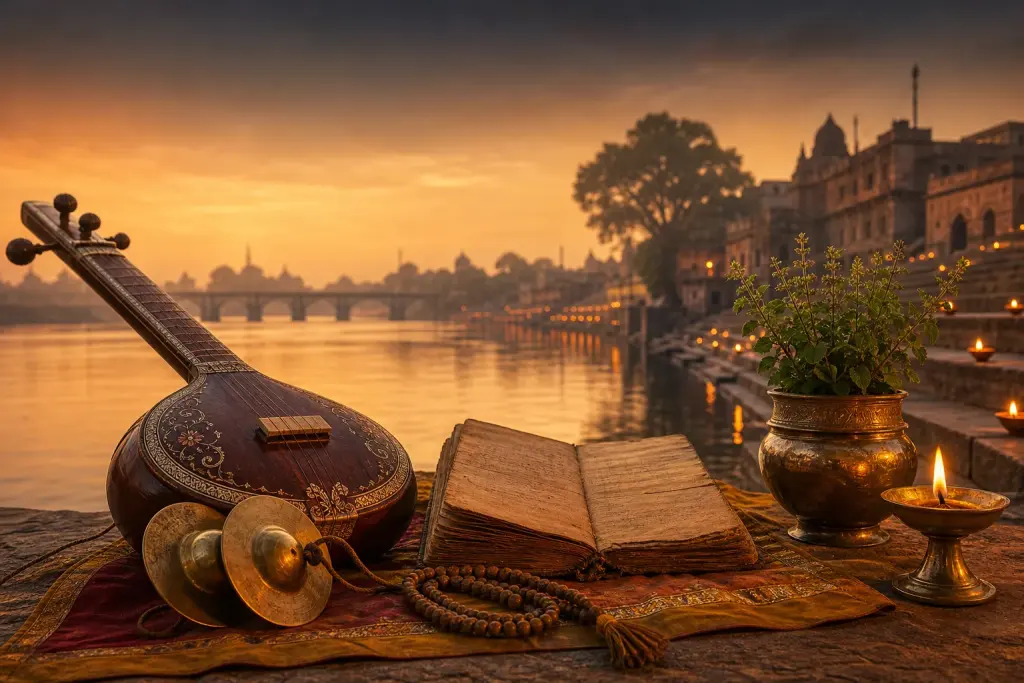
- Palkhi procession: a palkhi (palanquin) carrying the saint's symbols or padukas is taken in procession, accompanied by singing and the playing of cymbals and the mridang.
- Devotion to Vitthal: since Eknath's life was given to Vitthal of Pandharpur, the day's worship turns toward that form, with the chanting of his name.
- Gathering at Paithan: Varkari devotees come to Paithan, the saint's town on the Godavari, to mark the day at the place associated with his samadhi.
- Charity and seva: in keeping with his compassion across caste lines, many mark the day with acts of giving and service to others.
Regional variations
How this date is determined
Observed on the Shashthi tithi of Chaitra (Krishna paksha), reckoned by sunrise (udaya tithi).
Dates are computed to astronomical precision (NASA/JPL ephemeris), in line with traditional panchang.