Dharo Atham
When it falls
The date shifts because it tracks the moon, not the Gregorian calendar.
Calculated for India (IST) using precise Panchang astronomy. Dates can shift by a day at locations far to the east or west.
What Dharo Atham marks
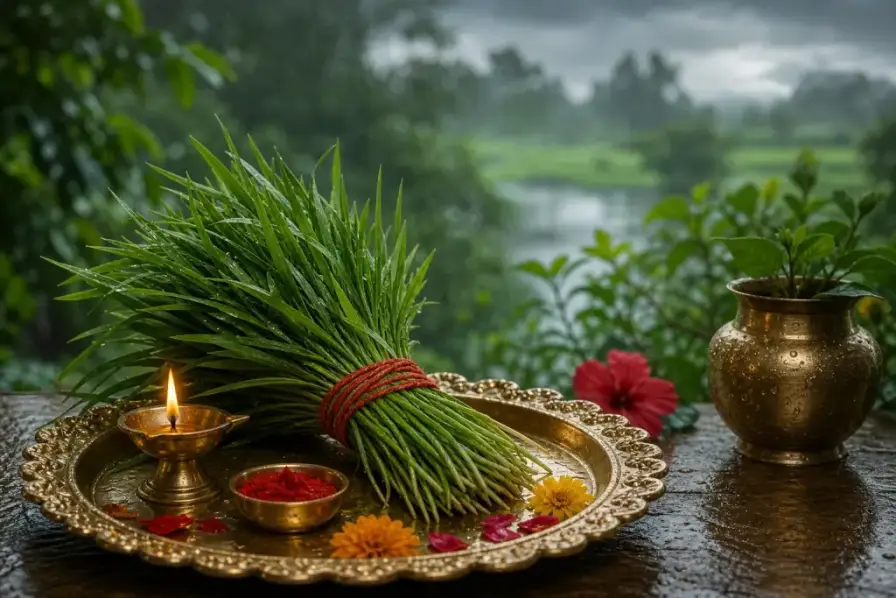
Dharo Atham, also called Durva Ashtami, falls on the eighth day (Ashtami) of the bright fortnight of Bhadrapada, the month Gujaratis call Bhadarvo. "Dharo" is the Gujarati word for durva grass, the same hardy, ever-green blade used in everyday Hindu worship, and the day takes its name from it. It is a small, home-centred observance kept mostly in Gujarat rather than a large public festival.
The heart of the day is a mother's prayer for her children. Married women and mothers worship the dharo grass and listen to the vrat katha (the story tied to the observance), asking for the health, wellbeing, and long life of their sons and daughters. Durva grass is chosen for good reason: it survives heat, drought, and being cut, and keeps growing back. That resilience is what mothers wish onto their children, so the grass works as a plain, living symbol rather than an abstract one.
The timing places Dharo Atham in the same stretch of Bhadrapada as Radha Ashtami, which shares the Ashtami tithi. In years when the tithi spreads across two mornings the two are kept on different days, but for most families Dharo Atham stands on its own as a quiet women's vrat with a clear, modest purpose.
Rituals & observance
Dharo Atham is kept simply, at home, by the women of the household. The customs are practical and centred on the durva grass and a light fast.
- Worship fresh dharo (durva grass), often arranged with green cloth, and offer it during the morning puja.
- Keep a vrat in which mothers and married women eat only once, in the evening; in many homes that meal is cooked the previous day so no fresh cooking is done on the vrat day itself.
- Listen to or read the Dharo Atham vrat katha, the story that explains the observance and its blessing for children.
- Pray specifically for the long life, health, and wellbeing of one's sons and daughters as the focus of the day.
- Elders bless the children of the house; in some families unmarried girls are blessed for a good marriage and married daughters are sent small Dharo gifts.
Regional variations
How this date is determined
Observed on the Ashtami tithi of Bhadrapada (Shukla paksha), reckoned by the forenoon (purvahna). Should the tithi fall across two days, tradition keeps the earlier day (purva-viddha).
Dates are computed to astronomical precision (NASA/JPL ephemeris), in line with traditional panchang.