Dhanu Sankranti
When it falls
The date shifts because it tracks the moon, not the Gregorian calendar.
Calculated for India (IST) using precise Panchang astronomy. Dates can shift by a day at locations far to the east or west.
Significance & story
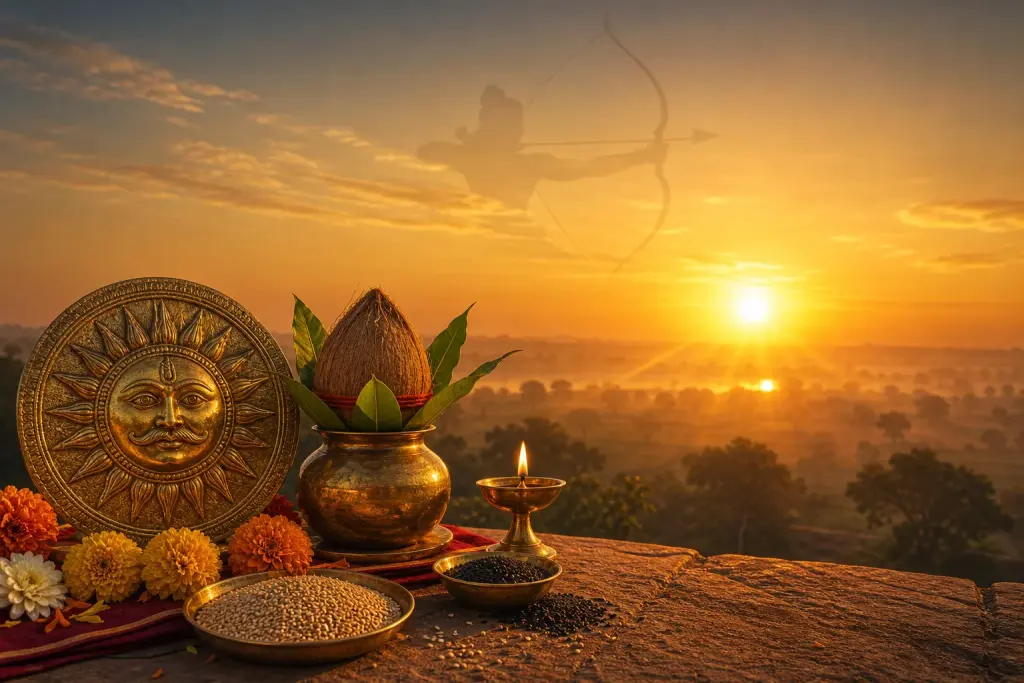
Dhanu Sankranti is one of the twelve solar Sankrantis — the day the Sun (Surya) passes from one zodiac sign into the next, here moving into Sagittarius (Dhanu). Because it is fixed to the Sun's position and not the Moon's, it falls around the same point in mid-December each year, drifting only very slowly over centuries. This is a solar date, not a lunar one, so it does not swing across weeks the way Moon-based festivals do.
The month that begins on this day, Dhanurmas (popularly called Kharmas, the "barren" or "dull" month), is treated as a pause rather than a celebration. Across much of North and East India, weddings, housewarmings, sacred-thread ceremonies and other major auspicious undertakings are traditionally not started during this stretch. The reasoning is calendrical rather than ominous: the Sun is seen as occupied in a transitional phase, and tradition holds back big new beginnings until it turns northward at Makar Sankranti. It is a low-key observance — closer to a seasonal note than a full festival.
Rather than outward festivity, Dhanurmas is given over to quieter devotion. In the Vaishnava tradition of South India it is the month of early-morning temple worship and the recitation of the Tiruppavai, and in Odisha the day is kept as Dhanu Sankranti with its own customs. The accent through the month is on prayer, simplicity and steadiness, with the bigger celebrations saved for the turn of the Sun a month later.
Rituals & observance
How Dhanu Sankranti is kept:
- As with every Sankranti, the day's core acts are a holy bath (snan) at first light and giving (daan) during the morning punya-kala — the meritorious window around the Sun's ingress, when bathing and charity are considered most fruitful.
- Offerings of water (arghya) are made to the Sun (Surya) as a mark of gratitude, often by those who keep a regular Sunday or Sankranti discipline.
- Through the Dhanurmas month that begins today, many families hold back from starting weddings, housewarmings and other major ceremonies, resuming them after Makar Sankranti — a practical custom worth knowing if you are planning dates.
- In Vaishnava households and temples of the south, the month is marked by pre-dawn worship and recitation of the Tiruppavai, with simple early-morning food offerings rather than elaborate feasting.
- In Odisha the day is observed as Dhanu Sankranti with temple visits and local customs, and in the Bargarh region it opens the well-known Dhanu Yatra season of open-air theatre.
- A modest, devotional tone suits the day: a temple visit, a small act of charity, and restraint with big new commitments fit the spirit of the month better than celebration.
Regional variations
How this date is determined
Observed on the sankranti, the day the Sun crosses into a new zodiac sign.
Dates are computed to astronomical precision (NASA/JPL ephemeris), in line with traditional panchang.