Dattatreya Jayanti
Lord Dattatreya
When it falls
The date shifts because it tracks the moon, not the Gregorian calendar.
Calculated for India (IST) using precise Panchang astronomy. Dates can shift by a day at locations far to the east or west.
Why Dattatreya Jayanti is observed
Dattatreya Jayanti celebrates the appearance of Lord Dattatreya, usually shown as a single figure with three heads and six arms. The three heads stand for the trinity Brahma, Vishnu, and Shiva, which is why Dattatreya is worshipped as the three brought together in one form. By tradition he is the son of the sage Atri and his wife Anasuya, whose devotion is said to have drawn the trinity to be born through them.
More than the mythology, Dattatreya is remembered as a teacher (guru). He is described as an avadhuta, one who has set aside worldly attachment, and he is closely tied to the Nath tradition of yogis and to many later saints of Maharashtra such as those linked with the Datta sampradaya. The well-known teaching credited to him is that he took twenty-four gurus from the natural world, learning patience from the earth, detachment from the wind, and steadiness from the mountain. The point is practical: wisdom can be gathered from ordinary observation, not only from formal instruction.
The day falls on the full moon (purnima) of the lunar month Margashirsha, which usually lands in November or December. It is observed most strongly in Maharashtra, Gujarat, Karnataka, and parts of central India, where Datta temples and centres associated with saints of this tradition draw the largest gatherings. Worship leans toward fasting, scripture, and quiet devotion rather than public processions.
Rituals & observance
Observance centres on fasting, scripture reading, and worship at Datta temples, often from the previous evening through the full-moon day. Common practices include:
- Keeping a fast (vrat) for the day, with many devotees taking only fruit and milk and breaking it after evening worship.
- Reading or listening to the Avadhuta Gita and the Guru Charitra, the texts most closely tied to Dattatreya and the saints of his tradition.
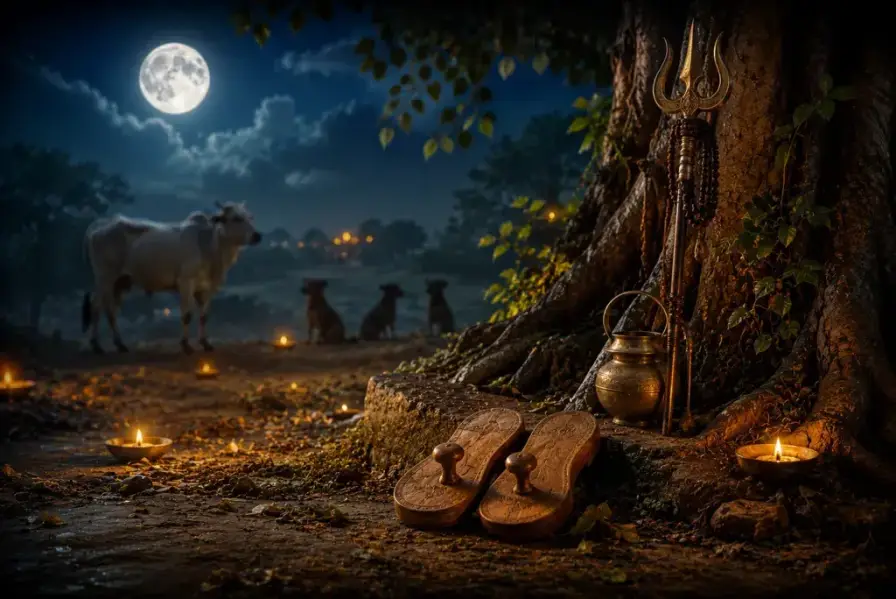
- Visiting a Datta temple for darshan, with worship of the murti that shows the three heads and the accompanying cow and four dogs.
- Offering lamps, incense, and simple prasad, and chanting the name of Dattatreya or the phrase Digambara Digambara Shripad Vallabha Digambara.
- Sitting for meditation or quiet recitation (japa), in keeping with the day's emphasis on the guru and inner discipline rather than display.
- Attending discourses or bhajans at centres connected with saints of the Datta tradition, where week-long readings sometimes conclude on this day.
Regional variations
How this date is determined
Observed on the full-moon day (Purnima) of Margashirsha (Shukla paksha), reckoned by dusk (pradosh kala). Should the tithi fall across two days, tradition keeps the later day (para-viddha).
Dates are computed to astronomical precision (NASA/JPL ephemeris), in line with traditional panchang.