Champa Shashthi
Khandoba (Martand Bhairav)
When it falls
The date shifts because it tracks the moon, not the Gregorian calendar.
Calculated for India (IST) using precise Panchang astronomy. Dates can shift by a day at locations far to the east or west.
What Champa Shashthi means
Champa Shashthi is the principal festival of Khandoba, also known as Martand Bhairav, a folk form of Lord Shiva and the kuladaivat (family deity) of many households across Maharashtra and the Deccan. Khandoba is revered as a warrior and protector deity, worshipped especially in the Deccan, and Champa Shashthi is the day on which his devotion reaches its height. It falls on Margashirsha Shukla Shashthi, the sixth day of the bright fortnight, usually in November or December.
The day is the concluding, sixth day of a six-day Khandoba observance. Families that keep a Khandoba navratri install a ghatasthapana on Margashirsha Shukla Pratipada and conclude the vow on Champa Shashthi, the sixth day. The observance honours Khandoba's victory over the demons Mani and Malla, a story that underlies his standing as a guardian who overcomes evil, and the six days build toward the festival's close.
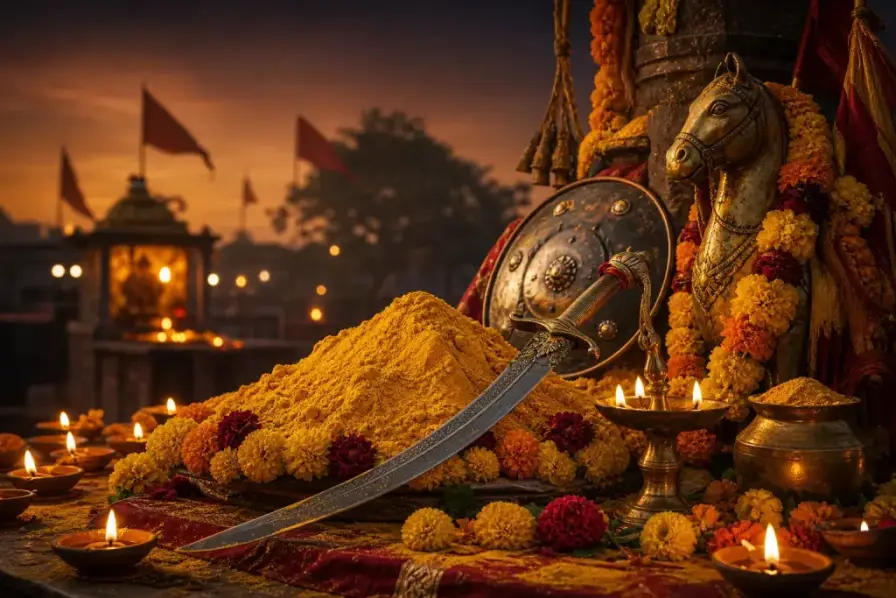
The hill temple of Jejuri, near Pune, is the great centre of the day, drawing large gatherings of devotees. The most striking custom is the showering of bhandara, the turmeric powder revered as the gold of Jejuri, which fills the air and covers the shrine and the pilgrims in yellow. A naivedya of brinjal and bajra, called bharit-rodga, is prepared and offered. Although related Shashthi names are used for Kartikeya observances elsewhere, this Champa Shashthi is the Maharashtra festival of Khandoba.
Rituals & observance
Champa Shashthi closes a six-day Khandoba vow and is kept both at home and at the temples, above all at Jejuri. Customs vary by family, but the central practices are shared.
- Concluding the six-day vow: families that keep a Khandoba navratri install a ghatasthapana on Margashirsha Shukla Pratipada and conclude the observance on Champa Shashthi, the sixth day.
- Worship of Khandoba: the deity is worshipped at home and at the temple, with lamps, flowers, and prayers honouring his form as Martand Bhairav, the protector.
- Showering of bhandara: turmeric powder, revered as the gold of Jejuri (bhandara), is showered over the shrine and the devotees, filling the air and covering the gathering in yellow.
- The bharit-rodga naivedya: a naivedya of brinjal and bajra, called bharit-rodga, is prepared and offered to Khandoba, and shared as part of the day's food.
- The gathering at Jejuri: great crowds gather at the hill temple of Jejuri near Pune, the principal centre of the festival, for darshan and the day's worship.
Regional variations
How this date is determined
Observed on the Shashthi tithi of Margashirsha (Shukla paksha), reckoned by sunrise (udaya tithi).
Dates are computed to astronomical precision (NASA/JPL ephemeris), in line with traditional panchang.