Amalaki Ekadashi
Lord Vishnu
When it falls
The date shifts because it tracks the moon, not the Gregorian calendar.
Calculated for India (IST) using precise Panchang astronomy. Dates can shift by a day at locations far to the east or west.
The Ekadashi of the amla tree
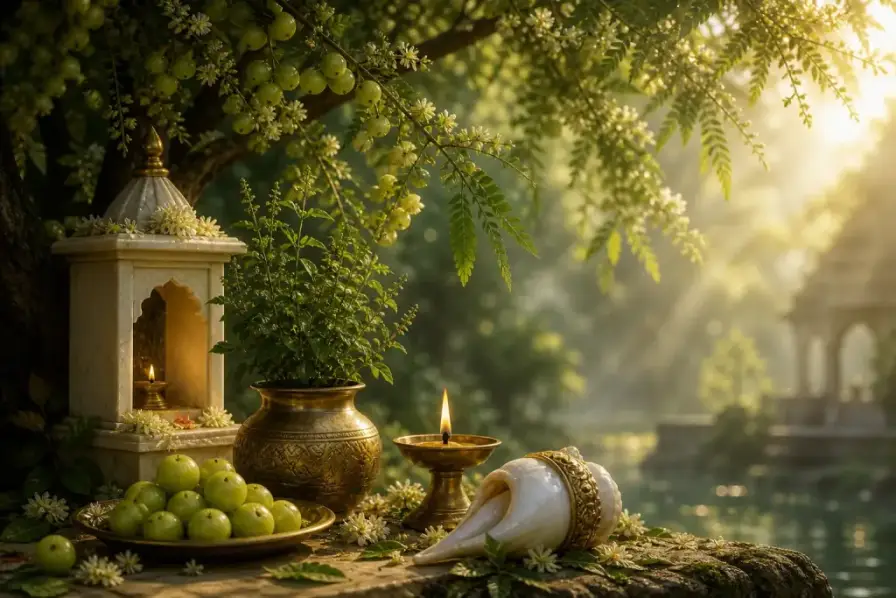
Amalaki Ekadashi is one of the twenty-four Ekadashis kept through the Hindu year, each falling on the eleventh day (tithi) of a lunar fortnight and devoted to Vishnu. This one belongs to the bright fortnight (Shukla Paksha) of Phalguna and is named for the amalaki, the amla or Indian gooseberry tree, which is held sacred to Vishnu. The day's particular merit is tied to honouring and worshipping that tree alongside the usual Ekadashi fast.
In tradition the amla tree is regarded as dear to Vishnu, and worship offered at its foot on this day is said to carry special merit. Devotees keep the fast, spend the day in remembrance of Vishnu, and direct their puja toward the tree, sometimes keeping a night vigil. The intention, as with every Ekadashi, is restraint and devotion rather than any single material reward.
Amalaki Ekadashi falls in the run-up to spring's biggest celebration: it comes two days before Holi, with the Holika bonfire on the following night. Because it is fixed to the eleventh tithi of Phalguna's bright fortnight rather than to a calendar date, it usually falls in March.
Rituals & observance
Observance follows the common pattern of an Ekadashi fast for Vishnu, with worship of the amla tree as its distinctive feature. Practice varies by family and tradition, but the usual elements are these:
- Keep the Ekadashi fast for the day. Grains, beans, and lentils are set aside; observers take fruit, milk, and water, while some keep a stricter waterless (nirjala) fast and others eat a single light meal of permitted foods.
- Worship Vishnu, often before an image of Vishnu or Krishna, with a lamp, flowers, and tulsi (holy basil) leaves.
- Offer worship at an amla (amalaki) tree where one is available, with water, a lamp, and flowers at its foot; some circumambulate the tree while praying.
- Spend the day in remembrance and recitation, reading or listening to Vishnu's praises and the story (katha) attached to the day; some keep a vigil through the night.
- Avoid grains and onion and garlic for the duration of the fast, and keep to simple, sattvic food when breaking it.
- Break the fast the next morning with parana, within the prescribed window after sunrise on Dwadashi, the twelfth day.
How this date is determined
Observed on the Ekadashi tithi of Phalguna (Shukla paksha), reckoned by sunrise (udaya tithi).
Dates are computed to astronomical precision (NASA/JPL ephemeris), in line with traditional panchang.