Ahoi Ashtami
Ahoi Mata
When it falls
The date shifts because it tracks the moon, not the Gregorian calendar.
Calculated for India (IST) using precise Panchang astronomy. Dates can shift by a day at locations far to the east or west.
The story and meaning of Ahoi Ashtami
Ahoi Ashtami is observed on the eighth day (Ashtami) of the waning fortnight (Krishna Paksha) in the month of Kartik, which usually places it about eight days before Diwali. The fast is dedicated to Ahoi Mata, a form of the Mother Goddess regarded as a protector of children, and is kept mostly by mothers for the wellbeing and long life of their children.
The day carries a well-known folk story. A mother, while digging or collecting clay near a forest, accidentally caused the death of a lioness's or a porcupine's cubs. The loss that followed in her own family was understood as a consequence of that act. On the advice of elders, she began worshipping Ahoi Mata with sincere prayer, and over time her children were restored or protected. The story is remembered less as literal history and more as a way of teaching care, accountability, and a mother's prayer for her children's safety.
In practice, Ahoi Ashtami sits in the same season as Karva Chauth, which falls a few days earlier, and the two are often kept by the same households. Where Karva Chauth centres on the husband, Ahoi Ashtami centres on the children. Both are part of the cluster of Kartik-season observances leading up to Diwali.
Rituals & observance
The day is built around a fast and a simple evening worship. Customs vary by family and region, but the common pattern looks like this:
- Mothers keep a day-long fast, usually without food and often without water (nirjala), from sunrise until the fast is broken in the evening.
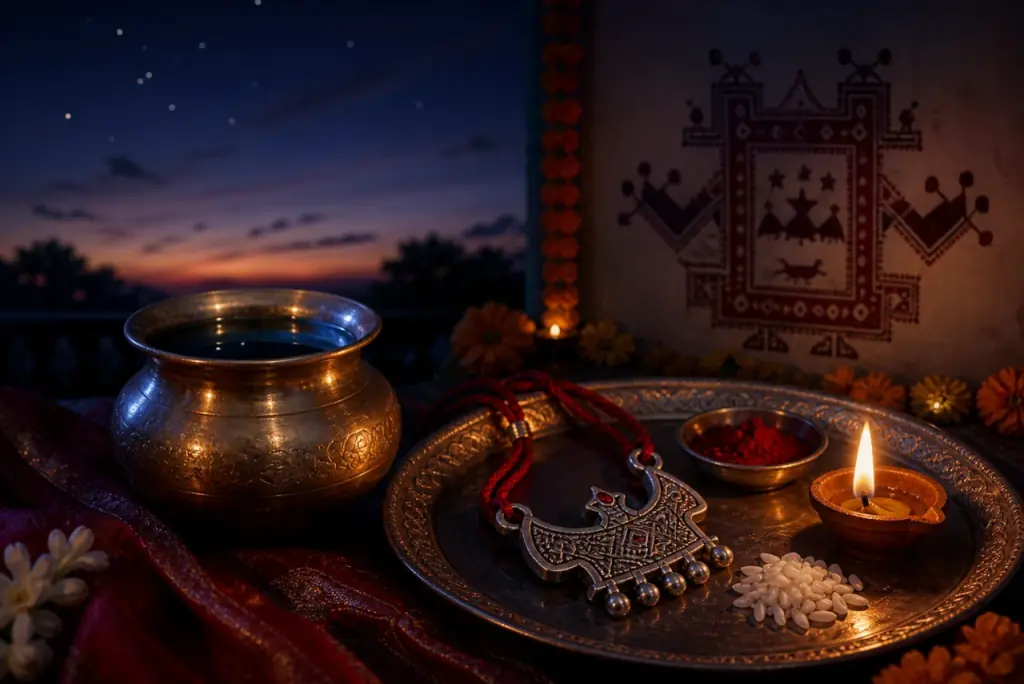
- An image of Ahoi Mata is drawn on a wall or paper, or a picture is used. The drawing traditionally includes the goddess along with her cubs, recalling the folk story.
- In the evening, the family gathers for the worship and the reading or telling of the Ahoi Ashtami story (katha), often using a small water pot (kalash) and offerings.
- Many families keep a silver Ahoi (sometimes strung as a necklace called the syahu), adding a bead or coin each year as the children grow.
- The fast is broken after sighting the stars in the evening. In some families, particularly in parts of North India, it is broken after the moon rises instead.
- After breaking the fast, mothers bless their children, and food prepared for the day is shared with the family.
Regional variations
How this date is determined
Observed on the Ashtami tithi of Kartik (Krishna paksha), reckoned by moonrise (chandrodaya). Should the tithi fall across two days, tradition keeps the earlier day (purva-viddha).
Dates are computed to astronomical precision (NASA/JPL ephemeris), in line with traditional panchang.