Mumbai (Bombay) Panchang for 11 May 2026
Monday,
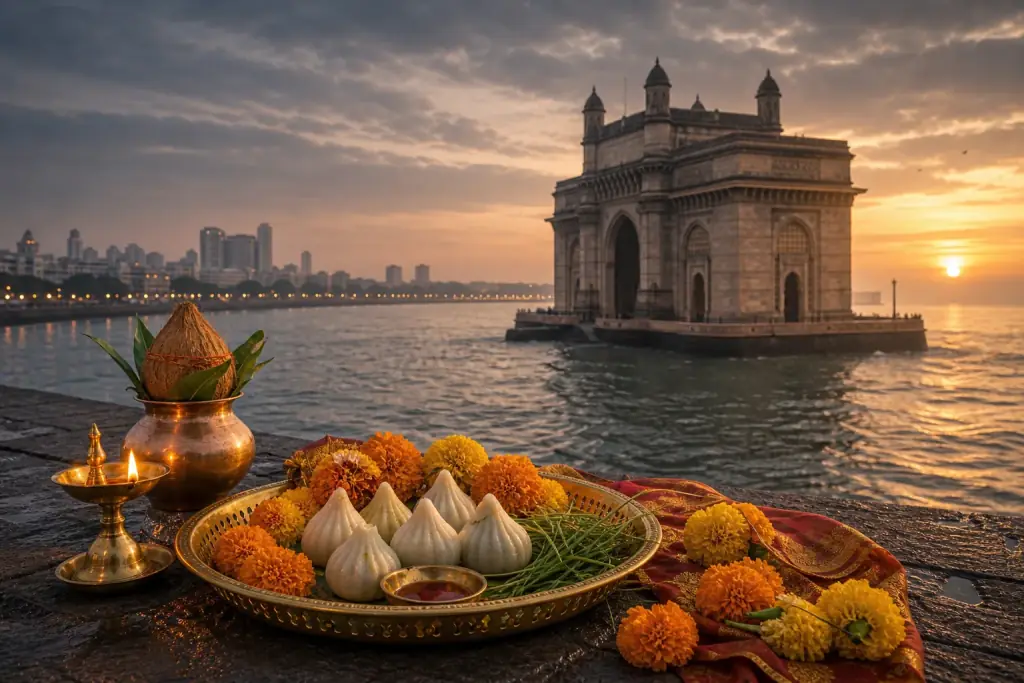
Vasanta (Spring)Mumbai's panchang reflects the coastal Maharashtrian heritage of India's largest city, anchored to the Amanta lunar-month tradition. Sunrise here is observed from the Arabian Sea horizon, which shifts panchang timings by several minutes from inland Maharashtra. The city's panchang carries forward devotional rhythms from Lalbaugcha Raja, Siddhivinayak, and Babulnath, and the timing of every aarti, tithi observance, and festival muhurat begins from this coastal solar reckoning.
Three festivals dominate Mumbai's panchang calendar. Ganesh Chaturthi, falling on Bhadrapada Shukla Chaturthi, transforms the entire city into a continuous procession for ten days, culminating in Anant Chaturdashi visarjan. Gudi Padwa on Chaitra Shukla Pratipada marks the Marathi new year with rangoli and ceremonial flag-raising. Diwali centres on Lakshmi Puja, with timing computed precisely against the day's pradosh kala. Local astrologers also closely watch the Sankashti Chaturthi monthly fast, observed at Siddhivinayak with a moonrise muhurat that varies by minutes between Worli, Andheri, and Navi Mumbai.
Day
Monday
Somvaar
Sunrise
6:06 am
Sunset
7:04 pm
Moonrise
2:34 am
Moonset
1:44 pm
Tithi
Nakshatra
Yoga
Karana
Auspicious Periods
View Details →Inauspicious Periods
View Details →Choghadiya
Muhurat Periods
Day Periods
Night Periods
Hora
Planetary Hours
Day Periods
Night Periods
Lagna
Rising Signs
Gowri Nalla Neram
South Indian Timing
Day Periods
Night Periods
Ayanamsa: Lahiri
More Calendar Tools
Hindu Calendar
View the full month with Tithi, festivals, and day quality
Festivals
Hindu festivals and important observances
Muhurat Finder
Find the best dates and times for important activities
Tara Bala
Nakshatra-based auspiciousness
Chandra Bala
Moon strength for the day
Special Yogas
Check for auspicious planetary combinations
What is Panchang?
Panchang — literally meaning 'five limbs' (pancha = five, anga = limb) — is the traditional Hindu calendar and almanac used across India for thousands of years. It tracks five essential astronomical elements for each day: Tithi (lunar day), Nakshatra (lunar mansion), Yoga (Sun-Moon angular combination), Karana (half-tithi), and Vaara (weekday). Together, these five elements form the backbone of Vedic timekeeping and are indispensable for determining auspicious moments for ceremonies, rituals, and important life events.
Unlike the Gregorian calendar which follows only the solar cycle, Panchang is a lunisolar calendar that harmonizes both the Moon's phases and the Sun's transit through the zodiac. Each day's Panchang readings change based on the precise positions of the Sun and Moon as observed from a specific geographic location. This is why Panchang timings in Mumbai differ from those in Delhi or Chennai — the calculations are inherently location-dependent, tied to local sunrise and sunset.
Panchang serves as the foundation for virtually all Vedic astrological timing. From choosing a wedding date to starting a business, from performing a housewarming ceremony to scheduling surgery, traditional Hindu families consult the Panchang to ensure their activities align with favorable cosmic rhythms. It remains one of the most consulted references in daily Hindu life, bridging ancient astronomical wisdom with practical everyday decision-making.
How Does Panchang Work?
The Panchang system begins with precise astronomical calculations of the Sun's and Moon's positions at the moment of local sunrise. From these positions, each of the five elements is derived mathematically. Tithi is determined by the angular difference between the Moon and Sun (each 12-degree segment constitutes one Tithi). Nakshatra is the lunar mansion occupied by the Moon (the ecliptic is divided into 27 equal segments of 13 degrees 20 minutes each). Yoga is calculated from the sum of the Sun's and Moon's longitudes (each 13-degree-20-minute segment gives one Yoga). Karana is half of a Tithi (each 6-degree segment). Vaara is simply the day of the week, each ruled by a specific planet.
Because the Moon moves approximately 12 to 15 degrees per day and the Sun moves about 1 degree per day, all Panchang elements change at different times throughout the day. A Tithi might end at 10:30 AM while the Nakshatra transitions at 3:15 PM. This is why accurate Panchang calculations require not just the date but also the exact geographic location — the local sunrise determines when each day's Panchang cycle begins, and the Moon's rapid movement means even a few hours can shift which element is active.
Modern Panchang calculations use a high-precision astronomical engine for planetary positions, combined with the Lahiri Ayanamsa (the official ayanamsa adopted by the Indian government) to convert tropical positions to the sidereal zodiac used in Vedic astrology. This ensures accuracy within arc-minutes, matching the calculations of traditional almanac publishers while being accessible to anyone with an internet connection.
The Five Elements of Panchang
There are 30 Tithis in a lunar month, divided into Shukla Paksha (waxing, 1-15) and Krishna Paksha (waning, 1-15). Each Tithi has specific auspicious or inauspicious qualities. Poornima (full moon) and Amavasya (new moon) are the most significant.
The 27 Nakshatras divide the ecliptic into equal segments, each with a ruling deity and planet. The Moon's Nakshatra at any given time influences the nature of activities — some Nakshatras favor travel, others favor ceremonies or business.
The 27 Yogas are derived from the combined longitudes of the Sun and Moon. Each Yoga has a name and nature — from the highly auspicious Siddha Yoga to the challenging Vyatipata. Yogas add another layer of timing guidance to the Panchang.
There are 11 Karanas, with 7 movable ones recurring eight times each month and 4 fixed ones appearing only once. Karanas provide finer granularity for Muhurat selection, with Bava, Balava, and Kaulava considered most favorable.
Each day of the week is ruled by a planet: Sunday (Sun), Monday (Moon), Tuesday (Mars), Wednesday (Mercury), Thursday (Jupiter), Friday (Venus), Saturday (Saturn). The Vaara lord influences which activities are favored on that day.
Frequently Asked Questions
Historical Origins of Panchang
The Panchang system has its roots in the Vedanga Jyotisha, one of the six auxiliary disciplines (Vedangas) of the Vedas, dating back to at least 1400 BCE. The sage Lagadha is credited with composing the earliest known Vedanga Jyotisha text, which established the mathematical framework for tracking lunar and solar cycles. Over the centuries, astronomers like Aryabhata (476 CE), Varahamihira (505 CE), and Bhaskaracharya (1114 CE) refined the calculations, introducing increasingly precise methods for computing planetary positions and calendar elements.
The tradition of publishing annual Panchang almanacs became widespread during the medieval period, with each region of India developing its own authoritative Panchang. The Rashtriya Panchang (National Calendar), established by the Indian government in 1957 under the Calendar Reform Committee led by Meghnad Saha, standardized the Lahiri Ayanamsa and provided a scientific framework for Panchang calculations. Today, digital Panchang tools carry forward this millennia-old tradition, making accurate daily readings accessible to anyone, anywhere in the world.
About Mumbai Panchang
When is Ganesh Chaturthi observed in Mumbai?
Ganesh Chaturthi falls on Bhadrapada Shukla Chaturthi each year. The exact date and the muhurat for sthapana (idol installation) are computed against Mumbai's sunrise; the panchang for that morning shows the precise window. Visarjan happens ten days later on Anant Chaturdashi.
Why does Mumbai's panchang differ slightly from Pune's?
Both cities follow the Amanta calendar, but Mumbai's coastal sunrise is roughly two to three minutes earlier than Pune's, which shifts every tithi-end and nakshatra-end timing by the same offset. For wedding muhurat or havan timing, the local panchang must be used.
What is the Sankashti Chaturthi moonrise time in Mumbai?
Sankashti Chaturthi is observed monthly on Krishna Chaturthi, with the fast broken at moonrise. The exact moonrise time differs by neighbourhood — South Mumbai sees it slightly earlier than the eastern suburbs. The panchang for the day shows the local Mumbai time.
Does Mumbai use Amanta or Purnimanta lunar months?
Mumbai follows the Amanta tradition, where the lunar month ends at the new moon (amavasya). This is the standard for most of Maharashtra. North Indian Purnimanta calendars differ by approximately two weeks in month-naming, which matters for festival cross-referencing.